Banco
The KillerBanco is a general, Macbett’s companion, and a participant in Duncan’s overthrow whose story turns on a prophecy he cannot control. The Witches promise him a royal line but deny him the crown; the prospect first consoles him, then sharpens his envy of Macbett. Macbett’s effort to extinguish that promised future by killing Banco comes too late: Lady Duncan later reveals that Banco is Macol’s father.
Identity and Position
Banco enters amid the political upheaval surrounding Glamiss and Candor. As they approach one another, they look toward the arriving general and greet him with ceremonious praise, calling him a gallant general and a great captain. The greetings establish his military standing and place him in the company of ambitious men already speaking of taking the ruler’s place. They do not, by themselves, establish exactly what Banco intends at that moment.
His bond with Macbett is presented as one of companionship and shared service. During the pursuit of the retreating forces, Banco tells Macbett that the opponents are nearly in retreat and asks him to take over while he rests. Macbett immediately says that Glamiss must not escape and goes to surround the rebels. Later, Banco recalls that he trusted and followed Macbett. Their association therefore carries both practical intimacy and political weight: Banco has served alongside the man who will become his rival, and he has also become entangled in the overthrow that brings Macbett to power.
Prophecy, Rivalry, and Reward
The Witches approach Banco from both sides and hail him as Macbett’s companion and as a general. He responds with suspicion and tries to drive them away with his sword. Their predictions then unsettle his confidence in the king’s favor. First, they say Duncan intends to grant the vacant title of Baron Glamiss to Macbett and return the estates to the crown. Banco objects that Duncan is loyal and keeps his promises, recalling that he expected a reward for Glamiss’s capture. The Second Witch names Macbett as his successful rival.
The Second Witch’s more alluring message comes through a voice Banco cannot locate. It promises that he will not be king but will be greater than Macbett: the root and father of many kings, whose dynasty will rule the country for a thousand years. Banco cannot decide whether he has seen and heard the Witches or dreamed them; he strikes at their apparent forms, which seem to change into wind, storm, and tree roots. Even after the voice tells him it is beside him and far away, he remains uncertain of its identity and power. The prophecy offers no immediate office or sovereignty, but gives him a future legacy against which Macbett’s present success can be measured.
Banco does directly claim the reward Duncan had promised for Glamiss, dead or alive. Duncan answers by asking where Glamiss is and saying that he cannot see him; Banco replies that Duncan knows he has drowned. The exchange exposes a gap between Banco’s expectation of payment and Duncan’s insistence on the absent captive. It also places Banco’s military service, the failed capture, and the political redistribution of Glamiss’s title in the same dispute over who is owed what.
Complicity, Ambition, and Remorse
In a private reflection, Banco counts Macbett’s advancement as a sequence: Baron Candor, Baron Glamiss, and then king. He says that the Witches’ predictions have come true one by one, but observes that they did not mention Duncan’s murder, in which Banco himself had a hand. He recognizes that Macbett could hardly have gained power unless Duncan died or abdicated, and that abdication was constitutionally impossible. Banco’s account thus makes his complicity explicit while also presenting the murder as a consequence he had not seen foretold.
He admits that he struck Duncan because he held a grudge, but finds that revenge has brought him little. Macbett has gained wealth, fame, power, and a wife, while Banco has no comparable advantage. Macbett has promised to make him chamberlain, but Banco doubts that promise because Macbett once pledged loyalty to Duncan and then killed him. Banco understands that others may judge his own betrayal by the same measure. Unlike Macbett, he says, he has none of the other man’s success or fame to smother his remorse, and he cannot put the crime out of his mind.
The prophecy both consoles and inflames him. Banco takes some comfort in the promise that he will father kings, princes, presidents, and dictators, yet recognizes that he has no children and is not married. He considers proposing to the Lady in Waiting, whose perceived ability to foresee danger might help them avoid it. In his imagined future, marriage and a family would accompany his appointment as chamberlain; from that position he would curtail Macbett’s power and act as an influential figure behind the throne. He even wonders whether the Witches might revise their prediction and allow him to reign in his own lifetime. He describes himself as newly consumed by envy and jealousy, ambitions that he says were absent before he met them.
Banco also joins a conspiracy against Macbett, swearing with the other conspirators to exterminate him. But his private plans remain dependent on promises, marriage, office, and the possibility of changing fate; none has yet secured the power he wants. When Macbett overhears Banco’s reflection, he interprets the prospect of Banco’s royal descendants as a threat to his own position and resolves to destroy Banco himself.
Murder and the Returning Ghost
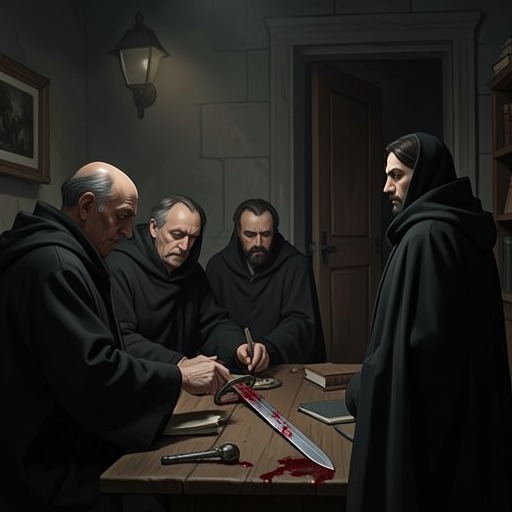
Macbett summons Banco and accuses him of repaying promised favors with treachery. He stabs Banco in the heart. As Banco falls, he asks for mercy; Macbett answers by asking where the predicted kings are and declares that they will die with Banco, cut off before birth. The murder is therefore not merely a personal reprisal. Macbett explicitly intends it to prevent the lineage promised by the Witches, while Banco’s death leaves the prophecy’s truth unresolved for the moment.
Banco returns as a ghost at Macbett’s feast, where the guests draw back in fear. He can now do no more than curse Macbett. Macbett denies that the apparition can make him feel remorse and justifies his action by accusing Banco of having struck first and of having killed Duncan. Banco answers with the reversal at the heart of their conflict: Macbett has taken the place of Duncan, who raised him through the titles of Baron. He says he trusted and followed Macbett, then was put under the spell of Macbett and the Witches. Macbett retorts that Banco wanted to replace his own descendants with Banco’s, and claims that Banco’s children and later descendants died in their seed. Banco warns that Macbett will face surprises and will pay for the murder. The exchange brings their shared history into the open, but it does not settle their competing claims or give Banco power over the living.
Fatherhood and Narrative Significance
The later revelation about Macol overturns Macbett’s confidence that killing Banco has destroyed the promised line. Lady Duncan explains that Duncan adopted Macol and sent him to Carthage to be educated, while Banco was his biological father. Macol’s mother, she says, was a gazelle transformed into a woman by a Witch; after giving birth, she became a gazelle again. Lady Duncan had secretly left court before the birth so that no one would know she was not pregnant, and Macol was accepted as the child of Duncan and Lady Duncan because Duncan wanted an heir.
Macol then declares his intention to resume his father’s name and found a dynasty lasting for centuries. Lady Duncan counters that Duncan cared for him and insists that he carry on Duncan’s family name. The conflict over Macol’s inheritance makes Banco’s legacy political rather than merely prophetic: his son’s parentage is hidden beneath Duncan’s adoption and contested between rival claims to a family line. Banco dies before this truth is exposed, while Macbett’s attempt to kill the future at its source fails because the heir is already alive. His arc consequently binds remorse for a past act, jealousy of a rival’s present power, and an unknowable dynastic future into one chain of consequences.